
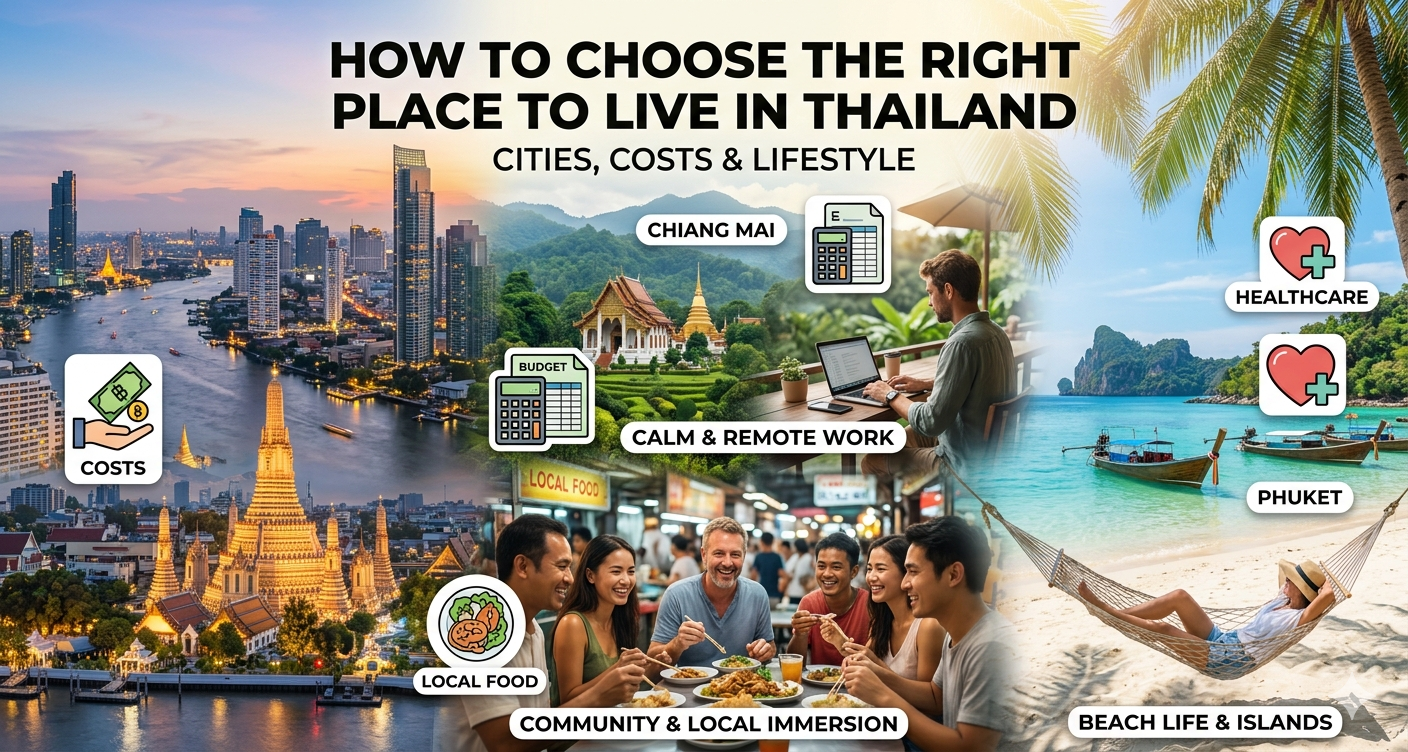
Picking your Thai home base can feel thrilling and overwhelming at the same time. Bangkok’s buzz, Chiang Mai’s calm, Phuket’s beaches, Koh Samui’s breeze. Each promises a different version of life. The fear, of course, is choosing wrong: committing to a lease you regret, realizing the climate isn’t for you, or discovering the hospital you need is hours away. This guide strips away the guesswork. You’ll get a simple decision framework, clear city snapshots by lifestyle, realistic budgets, and a low‑risk trial plan so your move feels confident.
Consider bookmarking this page and using the quick scoring tool below as you read. Many readers say it helped them narrow to two strong contenders in under an hour.
The quick framework: A Simple 7-Factor Framework to Choose the Right City
You don’t need a thousand data points, but you need the right ones. Rate each factor 1–5 for every location you’re considering, then weight them based on your priorities.
- Lifestyle rhythm (urban energy vs. slow‑lane)
- Climate tolerance (heat, humidity, air quality, monsoon timing)
- Budget vs. value (rent, utilities, transport)
- Healthcare access (distance to quality hospitals)
- Connectivity (fiber internet, airport links, ferries)
- Community fit (expat density vs. local immersion)
- Long‑term practicalities (schools, safety, drivability, language)
Suggested weights to start: Score each city from 1–5 and apply weights:
- Budget 25%
- Healthcare 15%
- Connectivity 15%
- Lifestyle 15%
- Climate 15%
- Community 10%
- Practicalities 5%
Tweak as needed.
Build a quick spreadsheet, multiply your 1–5 ratings by the weights, and see which filters rise to the top.
Thailand’s regions at a glance
- North (Chiang Mai, Chiang Rai, Pai): Mountain views, cooler winter nights, creative communities. Note: air‑quality “burning season” typically peaks late winter into early spring.
- Central coast (Hua Hin): Relaxed beach town within driving distance of Bangkok; popular with retirees and families.
- Eastern seaboard (Pattaya/Jomtien): Lively coastal city with excellent golf and year‑round social life; easy access to Bangkok.
- Andaman coast (Phuket, Krabi, Koh Lanta): Dramatic limestone scenery; wetter May–October; strong tourism infrastructure.
- Gulf of Thailand (Koh Samui, Koh Phangan, Koh Tao): Tropical island vibe; main rainy period often October–December; community‑driven pockets for wellness and remote work.
Don’t skip this: climate is the number‑one reason people move within Thailand after they arrive.
City‑by‑city snapshots: where each place truly shines
Each snapshot covers who it suits, why you’ll love it, trade‑offs to consider, micro‑neighborhood ideas, and a realistic single‑person budget range excluding international flights. Ranges vary by lifestyle; couples often add 40–60% to single
Pattaya/Jomtien
Best for: Social butterflies, golfers, people who want year‑round activity.
Why you’ll love it: Constant events, varied dining, multiple beaches, proximity to Bangkok and airports.
Trade‑offs: Nightlife zones may not suit everyone; choose micro‑location carefully.
areas: Jomtien for a calmer beach scene; Pratumnak for mid‑way convenience; Naklua for local flavor.
Typical monthly budget: 40,000–80,000 THB.budgets.
Bangkok
Best for: Urbanites, professionals, food lovers, frequent flyers.
Why you’ll love it: World‑class dining, shopping, and healthcare; two airports; endless neighborhoods to explore; reliable fiber internet.
Trade‑offs: Heat, traffic, and higher rents than elsewhere in Thailand.
areas to explore: Sukhumvit (Asok–Thonglor–Ekkamai) for convenience; Ari for a village vibe; On Nut/Phra Khanong for value; riverside for charm.
Typical monthly budget: 50,000–100,000 THB depending on rent and lifestyle.
Chiang Mai
Best for: Remote workers, creatives, retirees who prefer calm.
Why you’ll love it: Manageable size, strong expat networks, excellent coffee/coworking, access to nature, lower costs.
Trade‑offs: Air quality issues late winter/early spring; smaller job market for on‑site roles.
areas: Nimmanhaemin/Suthep for walkability; Santitham for value; Hang Dong/Mae Hia for houses and international schools; Old City for heritage.
Typical monthly budget: 30,000–60,000 THB.
Chiang Rai
Best for: Nature lovers seeking a quieter, lower‑cost base.
Why you’ll love it: Artistic vibe, gentler pace, nearby mountains and waterfalls.
Trade‑offs: Fewer nightlife and shopping options; farther from the sea.
areas: Around the Clock Tower and riverfront neighborhoods for easy access.
Typical monthly budget: 25,000–45,000 THB.
Pai
Best for: Bohemian slow‑lifers and wellness seekers.
Why you’ll love it: Community energy, cool season charm, lush countryside.
Trade‑offs: Remote roads, limited healthcare; village life isn’t for everyone.
areas: Near the walking street for convenience; out‑of‑town for views and quiet.
Typical monthly budget: 20,000–40,000 THB.
Hua Hin
Best for: Retirees, golfers, families wanting beach life without island logistics.
Why you’ll love it: Long beach, good hospitals, straightforward city layout, easy access to Bangkok.
Trade‑offs: Busy main road brings some noise; the city feels more practical than tropical.
areas: Khao Takiab for beach access; town center for amenities.
Typical monthly budget: 40,000–75,000 THB.
Phuket
Best for: Beach lovers who want island life plus strong infrastructure.
Why you’ll love it: International airport, marinas, distinct beach communities, great dining.
Trade‑offs: Higher costs; traffic on main roads; seasonal tourism swings.
areas: Rawai/Chalong for long‑term living; Kamala/Kathu for balance; Bang Tao/Surin for upscale pockets.
Typical monthly budget: 50,000–90,000 THB.
Krabi/Ao Nang
Best for: Scenic‑first lifestyles and weekend island‑hopping.
Why you’ll love it: Spectacular cliffs and islands, relaxed pace, good value off the beachfront.
Trade‑offs: Less urban convenience than Phuket; high‑season crowds in Ao Nang.
Micro‑areas: Krabi Town for affordability and markets; Ao Nang for beach and transport links.
Typical monthly budget: 35,000–70,000 THB.
Koh Lanta
Best for: Families and couples wanting a laid‑back island with space.
Why you’ll love it: Long, swimmable beaches, slower rhythm, community feel.
Trade‑offs: Smaller healthcare options; some services close in low season.
areas: Long Beach (Pra Ae) and Klong Dao for convenience; Kantiang for serenity.
Typical monthly budget: 35,000–65,000 THB.
Koh Samui
Best for: Island lovers who still want malls, hospitals, and schools.
Why you’ll love it: Mix of tropical and practical, good dining variety, regular flights to the capital.
Trade‑offs: Higher rents and transport costs; single ring road can jam.
Micro‑areas: Bophut/Fisherman’s Village for walkability; Maenam for quiet; Lamai for balance.
Typical monthly budget: 45,000–85,000 THB.
Koh Phangan
Best for: Wellness and remote‑work communities with a creative streak.
Why you’ll love it: Yoga, co‑working, beach coves, strong community ties.
Trade‑offs: Ferry access only; nightlife pockets not for everyone, so choose location wisely.
areas: Sri Thanu for wellness; Thong Sala for convenience; Haad Salad for calm.
Typical monthly budget: 35,000–60,000 THB.
Koh Chang and Koh Mak
Best for: East‑coast island life with fewer crowds.
Why you’ll love it: Lush jungle (Koh Chang) and bike‑friendly calm (Koh Mak).
Trade‑offs: Fewer flights nearby; healthcare is basic; very quiet off‑season.
areas: Klong Prao/Kai Bae on Koh Chang; Ao Kao/Ao Suan Yai on Koh Mak.
Typical monthly budget: 30,000–55,000 THB.
Cost of living: build a budget you can trust
Start by deciding your rent cap, then add recurring costs. Here’s a practical way to estimate a monthly budget for Thailand:
- Rent (studio/1‑BR condo or small house)
- Utilities and fiber internet (A/C use drives electricity)
- Mobile data plan
- Groceries and frequent local dining
- Local transport (motorbike fuel/maintenance or ride‑hails; ferries on islands)
- Healthcare and insurance (ongoing meds, routine visits)
- Leisure and short trips
- Buffer (unexpected fees, visas, seasonal price spikes)
Sample single‑person estimates:
- Chiang Mai remote worker: 12–20k THB rent; 3–5k utilities/internet; 8–15k food/leisure; 2–6k transport; 2–6k healthcare/insurance. Total: 30–60k THB.
- Bangkok professional: 20–40k rent; 4–7k utilities/internet; 12–25k food/leisure; 3–6k transport; 3–8k healthcare/insurance. Total: 50–100k THB.
- Hua Hin retiree: 15–25k rent; 3–6k utilities/internet; 10–18k food/leisure; 2–5k transport; 3–8k healthcare/insurance. Total: 40–75k THB.
Money‑saving moves:
- Choose buildings with good insulation and ceiling fans to cut A/C costs.
- Sign 6–12 month leases after a trial month for better rates.
- Live slightly inland from the beach for major rent savings without giving up access.
Track real expenses for 60 days before committing long‑term. If your actuals exceed estimates by 15%+, adjust the city or neighborhood—not just your lifestyle.
Healthcare and everyday safety: plan like a pro
Thailand’s larger cities offer excellent private hospitals with English‑speaking staff; island clinics handle routine issues, with serious cases referred to bigger centers. If you have ongoing medical needs, aim to live within 30–45 minutes of a tertiary hospital. Keep routine prescriptions documented, and consider comprehensive travel or expat health insurance that covers private care.
Air quality note: northern cities can experience smoky conditions late winter into early spring; many residents take seasonal beach breaks or use air purifiers during this period. Road safety: motorbikes are common; if you ride, invest in real training and a quality helmet.
Before you sign a lease, map the nearest hospital, clinic, and pharmacy and test the route at peak times.
Remote work and connectivity
Fiber internet is widely available in cities and major towns. Islands vary by area but continue to improve. For redundancy, pair home fiber with a generous mobile data plan and a hotspot‑capable phone or travel router. If your work is mission‑critical, ask landlords for recent speed tests and backup‑power info. Airport access matters, too: Bangkok (two airports) is Asia‑wide connected; Phuket has international routes; Chiang Mai offers strong domestic with some international; Samui and Krabi are convenient for the south.
Visas, rules, and renting
Visa categories and requirements change, so always verify with official sources or a qualified advisor. Common pathways include options for retirees, students, certain professionals, and long‑term stay categories. Remote work for an overseas employer typically requires careful compliance. Do not assume a tourist entry permits you to work.
Renting basics:
- Expect 1–2 months’ deposit plus first month’s rent.
- Clarify what utility rates you’ll pay (government rate vs. building rate).
- Photograph meter readings and any unit issues during move‑in.
- Avoid year‑long commitments before you’ve lived a full month in the neighborhood.
Use a bilingual addendum that lists inventory, meter readings, and refund timelines. These small details can prevent major headaches.
A low‑risk 30/60/90‑day trial plan
- Days 1–7: Land in your “hub” city (Bangkok or Chiang Mai). Get a local SIM, set up a temporary serviced apartment, and test daily life including groceries, gyms, co-working, and transport.
- Weeks 2–4: Visit your two alternate contenders. Spend at least three nights in each, living your normal routine. Do an evening walk from your top buildings to check noise, lighting, and feel.
- Month 2: Pick your front‑runner. Do a 30‑day rental in your preferred neighborhood. Trial‑run healthcare (routine check), commute patterns, internet, and weekly budget. Start a basic Thai class; it accelerates integration.
- Month 3: If the trial proves the fit, negotiate a 6–12 month lease. Join two community anchors (sports club, volunteer group, language exchange) to build roots quickly.
Keep a simple “living lab” journal to record sleep quality, noise, costs, commute time, air and water quality, and social life. Patterns beat impressions.
Common mistakes that cost time and money
- Ignoring seasonality. Picking an island in its rainiest months or settling in the north at peak smoke can sour first impressions. Time your trial to see a location at its “toughest” season.
- Overcommitting on a lease. Six weeks of testing beats six months of frustration and deposit disputes.
- Under‑insuring. Private hospitals are excellent, but you’ll want coverage.
- Underestimating transport. A cheap condo that forces daily long rides costs you time and money.
- Skipping basic Thai. A few phrases unlock friendlier prices and smoother problem‑solving.
- Bringing a Western grocery mindset. Embrace markets and seasonal produce, you’ll save and eat better.
Conclusion
Start with the seven‑filter framework and weight what matters most to you; short‑list three places. Respect seasonality and test each contender with a 3–7 day stay, living your normal routine. Build a budget from the rent outward and verify internet, hospital access, and commute times before signing anything. Expect Bangkok for urban convenience, Chiang Mai for calm and value, Phuket or Samui for island‑plus‑infrastructure, Hua Hin for practical beach living, Pattaya/Jomtien for a social coastal city, and Chiang Rai, Pai, Krabi, Koh Lanta, Koh Phangan, Koh Chang, or Koh Mak for quieter lifestyle niches. Commit only after a 30‑day neighborhood trial proves the fit.
Ready to choose?
Don’t let decision fatigue steal your momentum. Score your top cities today, line up two short stays, and give yourself a 90‑day trial to learn what truly fits. Many people discover their “just right” Thailand on the second try, because they tested with intention. Your best life in Thailand is closer than you think; take the first step now and let the right place reveal itself.
FAQ
What is the best place to live in Thailand?
The best place depends on lifestyle. Bangkok offers urban convenience, Chiang Mai suits remote workers, and Phuket or Koh Samui provide island living with infrastructure.
How much does it cost to live in Thailand?
A single person typically spends 30,000 to 100,000 THB per month depending on city and lifestyle.
How do you choose where to live in Thailand?
To choose where to live in Thailand, use a 7-factor framework that evaluates lifestyle, climate, budget, healthcare, connectivity, community, and long-term practicality. Compare cities using these criteria, then test your top choices with short stays before making a long-term commitment.
What is the safest way to move to Thailand?
The safest way to move to Thailand is to follow a 30/60/90-day plan: explore different cities, test daily life in your preferred location, and only sign a long-term lease after a one-month trial confirms costs, internet, healthcare access, and overall fit.


Recent Blog
Pattaya Walking Street Guide 2026: Costs, Nightlife & Local Tips
Thinking about a night out on Pattaya Walking Street? Good call. It’s Thailand’s most famous nightlife strip for good...
Read More
Is Pattaya Good for Diving? – An Honest 2026 Guide
If you’re weighing up Thailand’s dive spots and wondering whether Pattaya deserves a place on your itinerary, here’s the...
Read More